AHC Hall of Fame
Eddy Scheruga
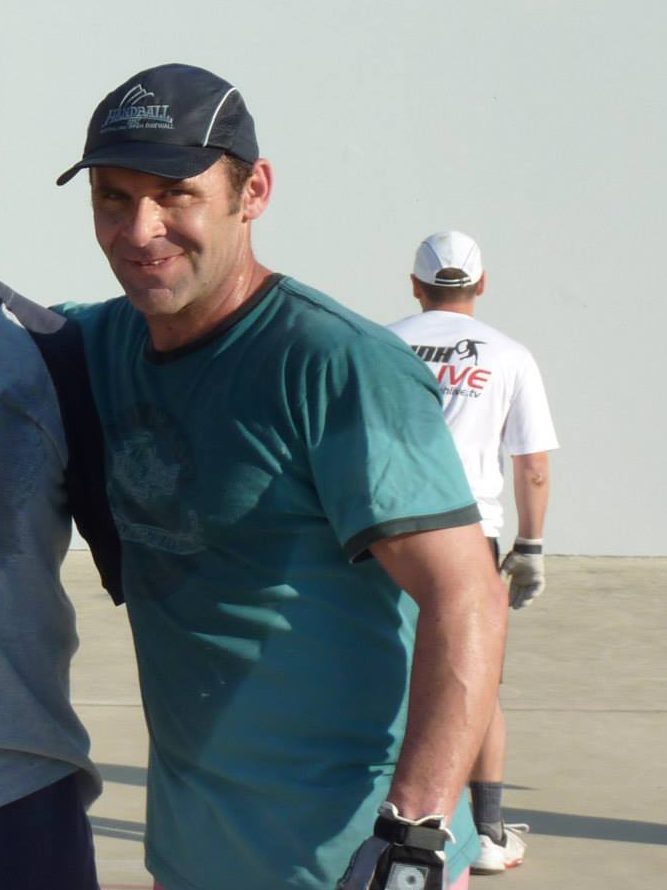
Eddy Scheruga
Eddy Scheruga has always been exceptional. He was of course the schoolboy prodigy, when between 1984 – 1986 he won three Australian junior single titles and three Australian junior double titles with Dom Di Sebastiano. He was training with the Clifton Hill A Grade at 14, quickly stormed into the O’Connor Cup arena (1988), and then emerged as a Four Wall world champion when he won as a 20 year old. Just 20, in Melbourne, the Worlds. By 1993 he was the Australian Singles champion and in a glorious match partnering Vince Costanzo, those two Clifton Hill brothers won the Australian Doubles against Peter Schreiner and Graham Lucas. Eddy would go on to earn seven Australian badges and three more titles and in any sense that makes him exceptional. Except that there is something more about Eddy.
There is something about who Eddy is, and the contribution that he has made, and the person that he has been for so many of us. There is something that is felt in our hearts and treasured by Australian Handball that makes him exceptional. When he sees you, speaks to you, there is a focus, almost an intensity. You matter. You seem the most important person at that moment. There is that smile of mischief, and real delight, when he shares a conversation. There is something exceptional about the strength of his hugs, so abandoned, so strong, that makes us feel…. well okay, uncomfortable… but important. There is something exceptional about his philosophy, his ideas, his vulnerability and his deep heart that cares and loves and plays and makes us laugh and demands that we think. His achievement as a player is absolute. His contribution as a person has been extraordinary. Eddy Scheruga has made a difference to our lives that has been exceptional, and that certainly makes him a worthy member of the Australian Handball Hall of Fame.
Eddy lived in Clifton Hill under the shadow of the handball court at St Thomas’. As little boy he wanted to play handball. The court excited him and he loved the big court even if the opportunity to play was limited. On the weekend 15 cars would park in the school asphalt and the senior players, big men of the Clifton Hill Handball Club, dominated the courts.
Eddy certainly ran up to the courts early before senior players arrived, but you had to be early. And there was a brick wall, he had a tennis ball, and he loved to play, and Cedar Ferry was three doors down the road and liked to hit as well. Clifton Hill was the dour, working-class club. It was on the other side of the railway line. Clifton Hill handballers learned their craft in the dusty, multicultural, industrial, St Thomas courts that glimpsed the Melbourne skyline. The club was conscious of two things that impacted on them and certainly had an impact on Eddy. Firstly, they all knew that it seemed more difficult to get into the O’Connor Cup side from Clifton Hill than other clubs. At least that’s how they felt. Secondly, the club was like a family. There was a loyalty to each other, a unity, and it was this membership that defined them. Eddy felt it especially. Belonging was important to him and if you belonged at Clifton Hill, they had your back. Eddy always played with a gratitude for that. He was conscious of the care and guidance that enabled him to play. People like Sam Nania, Joe Santilli, Gino Merlo, Jo Consoli, Wally Del Medico would support juniors, drive them around, coach, console, mentor. They were family. A Clifton Hill kind of family. The young emerging players like Domenic, Vince, John Remy, and Cedar saw themselves as the Clifton Hill mafia. They were truly brothers on an adventure. It was them together, confident, ambitious, invincible, the young guns who would take on the glamour boys at St Kilda, South Melbourne and North Melbourne. Eddy was part of this. It’s why his doubles partners always came from Clifton Hill. This family mattered. This was his tribe. They shared the battles and bravery together; the defeats and honour together.
In many ways it is the idea of family that has been the defining drive in Eddy’s handball life. After the tragic loss of his mother when he was a 13 year old, he needed people to care. His uncle Frank and family moved to Melbourne to support Eddy and his sister. The Di Sebastiano family had helped out, so had other relatives, but Uncle Frank and family were extraordinary. Eddy has never lost the sense of gratitude for the support that has been given. And this influenced his handball. He has always been thankful for the natural talent to play the game, but he is more thankful to the people who enabled this. People cared and his winning repaid their care. His drive to excellence honours other people’s efforts.
In the turbulence of early adolescence Eddy was a champion footballer, a neat, amenable student with precise handwriting, and then the angelic good looks that allegedly made him the teacher’s favourite. He managed the dark challenges of life with a precocious courage and resolve, he had support, and there was a protector hanging out over the fence just three doors down. And then Peter Vergona asked a question that changed it all.
Eddy was loving his football. He was winning acknowledgement and trophies. His uncle Frank encouraged years at the Croation dancing classes in the Church Hall. Eddy was graceful, fast on his feet, silk. Footy and dancing were perfect for him. He laughs at the idea that he learned his handball footwork from Croatian folk dance. Eddy was playing a good quality game of handball at the time and still running up to the court early on Sunday mornings to have a hit before the seniors arrived. Peter Dempsey was one of them. He had then joined Clifton Hill and he was a significant player who had a huge influence on Eddy in his early days.
But Peter Vergona asked him to decide about which sport. Peter saw potential.
Peter offered Eddy a trip to the United States to have a go. This was tracksuits and training, plane tickets and passports, strange courts, Irish kids and self-assured Americans. This was the glamour, the excellence and the ambitious world of international sport. Eddy found he could mix it with the best and he liked it. The handball was played within four walls.
This seemed to suit Eddy. Of course he had power, and of course he had strength for Three Wall, but within the confines it was the precision and the speed, it was the footwork and the timing. This seemed to be Eddy’s best space. Success came. Vergona was right. Eddy would become the World Champion 4-Wall Open Singles Winner in 1988 in Melbourne. And from here his handball flourished.
Eddy was not driven by anger to prove something to others. He was not a gladiator. He wasn’t necessarily wanting to beat his opponent but rather he wanted to be his best handball self. That’s fascinating. He wanted to be clinical and efficient, excellent, without being aggressive, cold and brutal. Eddy absolutely respected every opponent. He was restrained, respectful and scrupulously fair. He would never sacrifice honour for a cheap point. He never got involved with the crowd or an opponent. Games could be so fast, so brutal, so uncompromising, but never outside the glorious search for excellence. If he hit a jack butt to lose a three setter Eddy looked for the lesson, the learning. Okay, he could offer a reflective swear word to help determine what went wrong, but it was always about a self understanding, a philosophy of focus and reflection. It was about learning not complaining, improving not blaming.
Eddy found a court in Preston that had a fence behind capturing balls running off. He took handballs to the court by himself.
He began to learn the ball. He served spin continuously at it. He tried to master an understanding of the ball and the wall and the timing and the placement. And Eddy hit that ball continuously on the left and right sides of the court, with left and right hand. He was conscious of balance, discipline, and insight. He studied this spherical science, this physics between man and ball and velocity and space. It wasn’t that he wanted to be the best in Australia. He wanted to be the best he could be. The journey inevitably, simply, led him to national achievement.
Eddy enjoyed some wonderful partnerships. Clifton Hill partnerships. His journey with Domenic Di Sebastiano was exciting and fun. Three years of national achievement was an adolescent dream. They travelled the world together. Saw Ireland, America, played in ancient courts.
Won and lost big tournaments.
In 1993, Eddy enjoyed his first major national achievement with Vince Constanzo. They had won a magnificent doubles in Victoria before travelling to Adelaide. Vince hauled him down on the night before the championship doubles game and said “Come here and listen to
‘Eye of the Tiger’ and eat pasta de aglio e Olio.” It was the best recipe for victory*. The game was momentous.
His relationship with Cedar was always special. He loved the loudness, the posturing, the theatre of a Cedar game. He cared so much for Cedar and their journey together. They won at national level in a most emotional game against Cormie and Fitzgerald in 2014. This was Clifton Hill brotherhood at its closest. They just hugged and hugged. And Cedar was ever the protector.
However, probably the relationship with Vic Di Luzio was amongst the most significant. Eddy was in awe of the two handed accuracy and the deft surprise of spin that Vic brought to the game. Eddy studied the seamless, graceful technique of the Di Luzio style. Saw its effectiveness.
Saw that both hands could be such a weapon. He worked it into his own game. The two men became close. They could talk. They could spark. Maybe they listened. Maybe not. Certainly, they connected and they partnered memorably in the 1990s in 4 Wall and won against Jim Cormie and Dylan King in a classic encounter. More importantly Eddy was so happy that he got to share something with Vic. Partnerships matter to Eddy. Vic mattered. Eddy is always about the other.
One person who made a big difference to Eddy’s vision for handball was Chris King. Chris was the measure in the early 1990s.
If you were an emerging player and thought you were okay, you had to beat King. And that wasn’t easy. Eddy played Chris in the Victorian singles final in 1992. Eddy won the first game 15-3 and was 10-1 up in the second when Chris came back. Chris won 15-14 in the second, and 15-12 in the last. In 1993 it was the same. Eddy was 11-1 in the second and was ready to win when Chris started coming back again. “This has happened before,” Eddy thought. “What the f. is going on?” Eddy had to beat some demons within and trust in skills and his preparation. Trust in the Preston court and the support of his Clifton Hill his family. Eddy just got over the line. Chris was brilliant in his humble loss. “It’s all yours Ed. You take it from here.” Eddy was deeply moved. He had always felt second best in handball. That is amazing to think with all his talent, but then champions are complex. He always thought that he came from a place where he ‘owed’. He felt that this level of excellence paid back people’s efforts and faith in him. There was a debt, and he wanted to repay. There was a need, an absence, something solitary, personal and he wanted to belong. It was a hurdle to get over. And so on that day, that celebrated day, he jumped the hurdle.
Eddy Scheruga’s handball life is punctuated with absence and comebacks. He didn’t always manage the hurdle. He had to set aside life’s complexity to play. He found partners in the game and constructed a victory with them, and because of them. He played and won graciously for over 35 years. He gave us wonderful displays of handball. He had an enormous skill, and power and dignity on court. He honoured Easter Sunday afternoon by giving us so much of his ‘extraordinary. It came from within. From the grace of a Croatian folk dancer and the urgency and bursting strength of a footballer.
Eddy has wisdom, mysticism almost, a baffling, beautiful spirituality, and a life force that delights us. He entertains with story. He creates an enjoyment that is infectious, an enthusiasm that is compelling. He fills hearts with love and laughter. It is so much fun. Eddy is unique.
Delightful. Just so good. Exceptional really. Handball is richer for having Eddy Scheruga and he doesn’t owe us a thing.
1-Wall
Australian Open Titles
Singles: 2002, 2003
Doubles: 2002, 2003, 2012, 2013
3-Wall
Australian Open Titles
Singles: 1993, 1999
Doubles: 1993, 2000, 2014
Victoria Open Titles
Singles: 1993, 1999
Doubles: 1993, 2000, 2002, 2014
Australian Team Selections (Underlined years represent AUS Team Captain selections)
Team Selections: 1991, 1992, 1993, 1999, 2000, 2003, 2014
O’Connor Cup Champion
Victoria: 1990, 1991, 1992, 1994, 1995, 1997, 1998, 2000, 2004, 2005, 2006, 2007, 2012
Australian Junior Titles
Singles: 1984, 1985, 1986
Doubles: 1984, 1985, 1986
Australian Super Masters Titles
Doubles: 2018
4-Wall
Australian Open Titles
Singles: 1988, 1992
Doubles: 1991, 2013, 2017, 2018
Australian Masters Titles
Doubles: 2012 (SB), 2013 (SB)
George Macris Medal
Australian Player of the Year
2013
International
Handball World 4-Wall Championships
Open Singles: 1988

